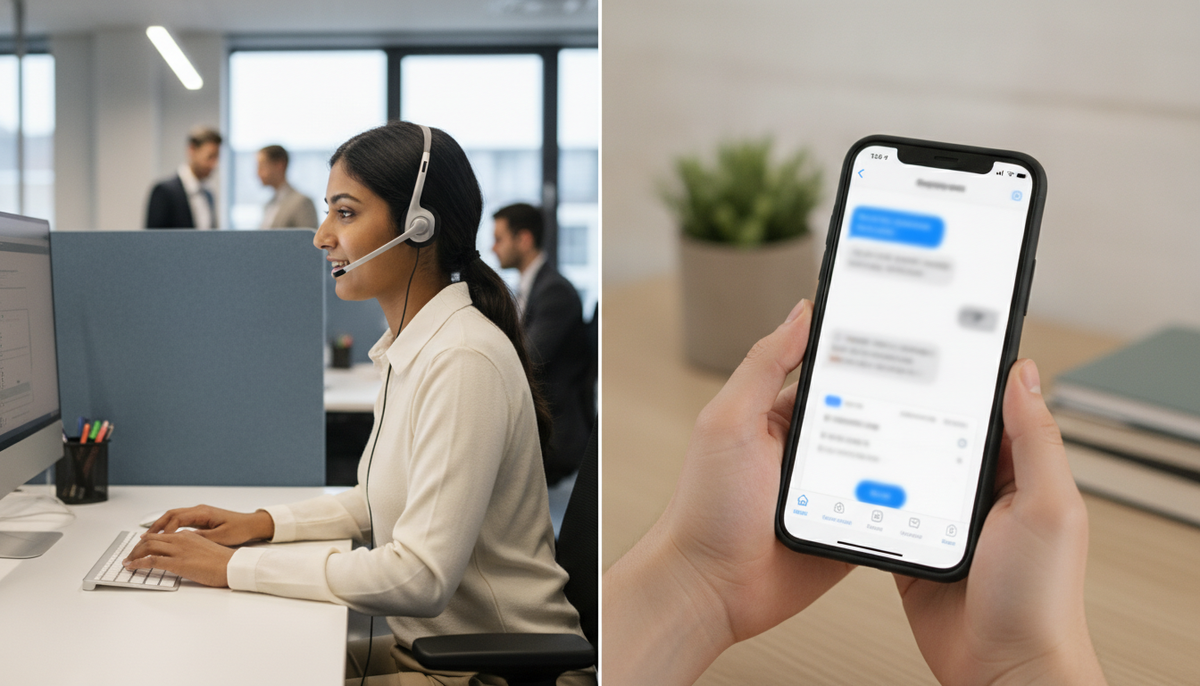
If your phone rings while everyone is with clients, you have three choices: let it go to voicemail, pay a human answering service to take a message, or use an AI receptionist that answers, asks your questions and books a meeting. Many firms now weigh an AI receptionist against an answering service, and the honest answer is that they suit different situations.
This guide compares the two for accountants, financial advisers and law firms, and explains when it makes sense to combine them.
What each one does
A human answering service
A virtual receptionist or answering service is a team of people who answer your calls in your firm's name. Typically they greet the caller, take a message, and pass it on by email or text. Some can book into your diary or transfer urgent calls. Many firms like the reassurance of a real person, particularly for existing clients.
An AI receptionist
An AI receptionist is software that answers calls and website or messaging enquiries. It can greet the caller, ask the qualifying questions you set, answer factual questions about the firm from approved information, book a meeting directly into a diary, and pass a written summary to your team. It works the same way at any hour and does not get busier in January.
We describe how this works in practice in AI receptionists: turning missed calls into booked meetings.
How they compare
Coverage
Answering services vary: some cover office hours only, some offer extended or round-the-clock cover at extra cost. An AI receptionist covers every hour and every channel by default, including website chat and messaging, which many prospective clients prefer to phoning.
Qualification
A human service usually takes a message. An AI receptionist can ask a defined set of questions every time, such as business type, the service needed or the urgency, so your team knows who they are calling back and why. Consistency is the main advantage: it never forgets a question.
Booking
Some answering services can book appointments; many simply pass on a message, which means another round of calls before a meeting is in the diary. An AI receptionist can offer real availability and book on the spot.
Handling the unexpected
This is where people still win. A distressed existing client, a complex complaint or a call that needs judgement is better handled by a person. A good AI receptionist recognises these situations and hands over, either by transferring the call or by flagging an urgent callback.
Cost structure
Answering services typically charge per call or per minute, often with a monthly minimum. AI receptionists are usually priced by subscription and setup. Which is cheaper depends on your call volume and how much each enquiry is worth. For most firms the bigger cost is not the service itself but the enquiries lost when nobody answers.
Compliance
Neither option should give advice. With a human service, you rely on staff training to stay within that line. With an AI receptionist, you define exactly what it can say, and it does not improvise outside that script. In both cases, call data must be handled under UK GDPR, and recordings and transcripts should be stored securely in systems the firm controls.
When each makes sense
A human answering service suits firms that:
- receive mostly calls from existing clients who expect a person
- handle sensitive or emotional situations often, such as family law or bereavement
- have low enquiry volumes and value a personal touch over speed
An AI receptionist suits firms that:
- lose new enquiries outside office hours or at busy times
- want every enquiry qualified the same way
- want meetings booked directly rather than messages to return
- receive enquiries through website chat and messaging as well as phone
Using both
Many firms get the best of both by combining them. The AI receptionist handles new enquiries, out-of-hours contact and booking, while existing clients and urgent matters are routed to a person, either in the firm or through an answering service during office hours. The split can be decided by the caller's answers or simply by which number they rang.
Common questions
Will callers know they are speaking to AI?
They should. Being open that an assistant is automated is good practice and supports trust, and it should always be easy to reach a person. Most callers care more about getting a fast, accurate answer and a booked appointment than about who answered.
Can an AI receptionist give advice?
It should not. It can answer factual questions about your firm from information you approve, ask qualifying questions and book meetings. Any discussion of a caller's personal circumstances, and anything that could be read as advice, should go to a qualified person.
How long does an AI receptionist take to set up?
Setup mostly involves agreeing the questions, the information it can share, the handover rules and the calendar connection. For a typical professional firm that is a matter of days to a few weeks, depending on how many services and team members are involved.
Questions to ask any provider
- What happens when the caller asks something outside the script?
- Can it hand over to a person, and how?
- Where are recordings and transcripts stored, and for how long?
- Can it book directly into our calendar system?
- How do we change the questions and information it uses?
- What does it cost at our current enquiry volume, and at double that volume?
If you would like to see how an AI receptionist would work for your firm, see our AI receptionist page, or read about lead generation for accountants for how it fits into a wider enquiry system.